
How NRCS Funding Shapes Working Lands, Wildlife Habitat, and the Policy Systems Behind Them
Policy Desk provides look into systems behind conservation work: the Farm Bill, NRCS programs, and the broader forces shaping management. These pieces connect ecological reality with policy architecture to help readers understand how decisions made far from the field echo across working landscapes.
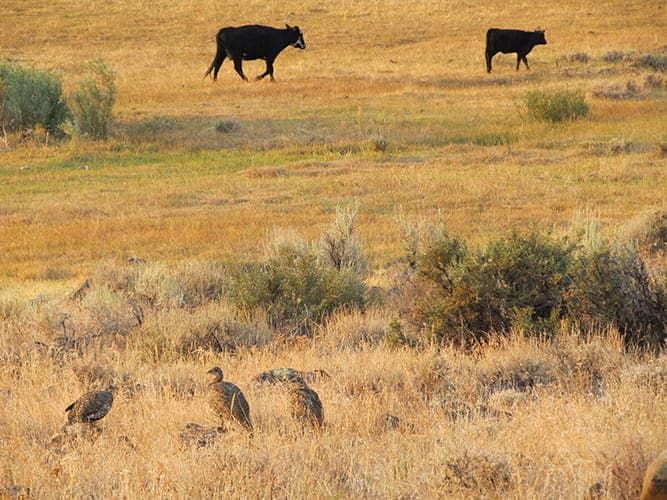
On a cold morning in Perry County, Alabama, a landowner, an NRCS conservation planner, and a wildlife biologist stand together in the middle of an old hayfield. Frost lies on the broomsedge. A covey of quail flushes at the trio’s approach, disappearing into a tangle of blackberry and goldenrod. The landowner wants this field restored to early-successional habitat. The biologist sees a canvas ready for fire, soil exposure, and native forbs—an ideal candidate for a disturbance regime backed by contemporary wildlife research. The NRCS planner, however, carries a binder thick with practice standards, liability considerations, and state-wide program rules that will govern what can and cannot be funded.
They are looking at the same field. But each is seeing a different story: the landowner sees possibility; the biologist sees ecological processes; and the planner sees the limits and promise of a federal program whose framework was built decades before early-successional ecology became widely understood. This moment of tension—between science, private landownership, and federal policy—is where modern NRCS work lives.
A Mission With Deep Roots and Slow Evolution
The Natural Resources Conservation Service traces its origins to the Soil Conservation Service of 1935, created during the Dust Bowl as a response to ecological disaster. Its focus then was narrow and urgent: stop the soil from blowing away. Early SCS work centered on terraces, contour plowing, shelterbelts, erosion control, and hydrologic engineering—practices grounded more in agronomic stability than ecological complexity.
When SCS became NRCS in 1994, the mandate expanded dramatically. No longer limited to soil erosion, the agency now held responsibility for wildlife habitat, forest health, wetland restoration, grazing systems, air quality, and climate resilience. With each Farm Bill, Congress layered new priorities on top of the old: carbon, pollinators, endangered species, nutrient management, flood mitigation. The agency became the central financial engine for private-land conservation in the United States.
Yet for all its expansion, the foundational operating architecture remained conservative—in the literal sense of the word. Practice standards had to be uniform across states, contract requirements had to be legally defensible, and funding had to be auditable. While ecological science advanced rapidly—documenting the importance of disturbance, patchiness, diversity, and time-sensitive habitat structure—NRCS’s ability to rewrite national standards lagged behind.
The mission grew faster than the rules that shaped how the mission could be implemented.
Where Science Outpaced Policy
Few areas show this friction more clearly than early-successional habitat management. Research from scientists such as Dr. Craig Harper has demonstrated that the quality of wildlife habitat—especially for species like quail, field sparrows, or brood-rearing turkeys—depends on very specific disturbance timing, multi-year rotational disking, frequent fire, and the maintenance of bare ground interspersed with native forbs.
Harper’s work illustrates that “wildlife openings” planted with standard seed mixes often provide far less ecological benefit than a field disturbed every one to two years. Yet many NRCS practice standards limit disking to three- or five-year cycles, restrict burning windows for administrative simplicity, or default to commercial seed blends primarily intended for ease of verification. The science is dynamic; federal contracts are not.
The result is a system in which the ecological ideal cannot always be funded—even when everyone in the field agrees on what the land needs.
Real-World Examples: Where the Program Helps—and Where It Stumbles
This mismatch between ecological science and program constraints appears across the landscape in subtle but important ways.
Food plots, for instance, remain a common NRCS-supported practice in some states because they are easy to design, measure, and verify. Yet their ecological value is sharply limited outside deer management. They concentrate browsing pressure, suppress native vegetation, and rarely provide meaningful structural habitat. Meanwhile, early-successional disturbance—often more beneficial and more aligned with modern wildlife science—can be harder to contract because its outcomes are more variable.
In southern forests, NRCS has historically supported loblolly pine establishment, thinning, and management—a reflection of both economic realities and long-term agency partnerships with the timber industry. These pine monocultures are efficient carbon sinks and predictable sources of income, but they reduce structural complexity and can create long periods of poor wildlife habitat between thinning cycles. The agency is increasingly encouraging mixed pine–hardwood regeneration, yet the landscape still carries the imprint of decades of policy inertia.
Other cases demonstrate NRCS at its best. The growing concern about white oak regeneration has aligned timber markets, wildlife science, and agency programs in a rare moment of unanimity. Cost-share support for shelterwood systems, understory control, prescribed fire, and oak regeneration planning reflects the agency’s ability to adapt quickly when ecological need, economic incentive, and practical implementation converge.
The Equity and Access Challenge
Even when practices align with ecological science, access to NRCS programs is far from uniform. The administrative realities of NRCS participation—paperwork, mapping requirements, multiple site visits, monitoring obligations, and multi-year compliance—favor landowners with time, transportation, financial reserves, and prior familiarity with federal programs. A landowner who cannot front costs before reimbursement, who works a full-time job, or who lacks reliable broadband may find the process prohibitive.
The legacy of USDA discrimination against Black farmers—acknowledged in landmark settlements like Pigford v. Glickman—continues to influence trust and participation patterns today. Many socially disadvantaged landowners still report lower awareness of programs or less capacity to meet administrative demands. NRCS is actively working on equity initiatives, but the structure of the programs themselves can unintentionally reinforce disparities.
Access challenges also appear in non-traditional ownership systems. Tribal trust land, heirs’ property, and communal land systems do not map neatly onto NRCS contracting requirements. Issues of clear title, federal trust responsibility, or non-uniform ownership can delay or prevent participation, even in communities with strong conservation traditions.
Scale matters too. Larger parcels often rank more competitively because practices cost less per acre and meet minimum-size thresholds more easily. Small woodlots, urban-edge parcels, or highly fragmented landscapes may qualify on paper but struggle to compete in statewide ranking pools designed around agricultural economies of scale.
A System That Is Indispensable, Imperfect, and Structurally Important
For all its limitations, NRCS remains the most powerful vehicle for conservation on private lands in the United States. Its programs have restored wetlands, stabilized eroding watersheds, improved grazing systems, enhanced forest structure, reduced sediment loads, and brought ecological practices such as prescribed fire back onto landscapes where they had nearly disappeared. Every year, thousands of landowners use cost-share programs to make real improvements: thinning overcrowded stands, removing invasive vegetation, repairing streambanks, augmenting hydrology, and improving wildlife habitat.
Yet the program’s strengths and weaknesses are inseparable. The very features that make NRCS predictable—uniform practice standards, contract enforceability, clear specifications—are the same features that limit ecological flexibility. The agency’s mission demands innovation, but its regulatory framework necessarily rewards consistency.
The central question for the next decade is not whether NRCS is valuable. It is whether NRCS can evolve rapidly enough to meet the ecological challenges of a changing landscape: intensifying storms, drought cycles, invasive species, altered fire regimes, and shifting economic pressure on rural landowners. The science is moving quickly. The climate is moving faster. The institution is doing its best to keep pace.
Where Conservation Professionals Fit Into This Picture
For foresters, habitat managers, and ecological consultants, NRCS programs function less like a solution and more like a toolkit. Used well, they accelerate high-quality stewardship. Used uncritically, they can inadvertently reinforce outdated practices or ecological inefficiencies. The professionals who work between ecological science and federal policy become translators—helping landowners understand both the opportunities and limitations of the system while shaping on-the-ground outcomes that reflect long-term ecological thinking.
This work, at its best, is not just about funding. It is about stewarding the dynamic relationship between people, land, and the policies that shape what becomes possible on private ground. It asks practitioners to navigate the tensions between science and structure, to honor the agency’s legacy while pushing it toward innovation, and to see each property as a negotiating space where ecology, economics, and history intersect.
And sometimes, it begins in a frost-covered field with three people looking at the same land through three different lenses—trying to bring them into focus.